
Guide To Ice Fishing


Catching Fish in Winter
Last updated on .
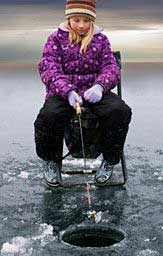 Ice fishing is a great way to fill the freezer with filets during the cold winter. Ice fishing can be done with a minimum of tools and gear, or can be done with all the latest in ice fishing technology.
You can use an axe to cut the hole, or one of the many hole-cutting tools and augers on the market. You can stand in the open air or use any variety of protective structures, some are literal cabins with many comforts like heaters and cooking facilities.
Safety Issues. As a rule, clear ice is stronger than frosty white ice. 4 to 5 inch thick ice is quite generally considered safe. The best source of information regarding the safety of the ice, is the local governing body for the lake (fish and game department, state agencies, bureau of land management, etc.). Be aware of portions of the lake that do not freeze as thick (because of current, underwater springs and etc.) as other areas, and avoid them.
Safety equipment. A length of rope (20-25 feet) is very handy should someone fall through the ice. A set of ice picks, that you carry on your person, to allow you to stick them in the ice, and pull yourself up out of the water. Ice cleats for your boots, for traction.
Where to Fish
Like all other styles of fishing, the key is locating the fish. Once located they can be quite easy to catch. Their food supply is scarce so your offerings can look quite appealing to a hungry fish.
Seek out ice fishing reports for the area you intend to fish. Prior years reports are often archived on websites and local newspaper archives. Prior years reports can give you a good idea when the good fishing should start. It's a good idea to keep your own log tracking dates of the activity.
Once you arrive at your chosen lake, the next step is to determine exactly where to fish. If you know the lake well, you are aware of places that hold fish during the warmer months. Those fish will move to deeper water nearby their summer hang outs. If you don't know the lake, find a good map. Locate deeper water near shallow feeding areas. Often, congregations of ice fisherman tell you everything you need to know. Go around and ask questions about the bait or lures and the depth fish are being caught. Try to duplicate what the other successful anglers are doing. Set up close to the other fisherman yet far enough to respect their space.
During these ice-over conditions all fish look for the warmest water they can find. That's usually where you find the fish, and the food sources.
Cutting a hole in the ice
A six-inch diameter hole is sufficient for 95% of ice fishing situations. Four inch can work for small fish, and eight inch works for larger fish, but is harder to drill with a hand auger. Holes can be cut with a hand, or power, auger, or you can chop a hole with a hatchet. Always bring an ice chip scoop to keep the hole from freezing shut. A 5-gallon bucket is handy for carrying your gear and taking fish home.
Basic rod, reel and line setup
Rods. Short rods (24") are better than long rods, although you can get by with your everyday setup if need be. Reels. Spinning reels, bait casters or push-button reels all work fine. For lighter baits, spinning reels allow the bait to submerge faster. Spinning reels have a good braking system which assists when you catch larger fish. Line. Light (8 to 15 pound) braid works well as a primary line, and a leader of 4 or 6 pound fluorocarbon line is an ideal leader for most ice fishing. Use heaver lines if you expect bigger fish. All sorts of specialty rods are available for anglers wishing to expand their ice fishing capabilities. Tip-ups. These setups have a flag which pops up when a fish takes the bait, and are designed to for hand-lining the fish, rather than using a reel. 12-15 pound monofilament line works best.
Do I need a fish finder?
Most anglers fish without one, but they can certainly enhance your catch rate. Options and pricing can vary significantly
How deep to fish?
For starters, it depends on the available depths and contours of the lake. As they say.. fish the depth where the fish are. This is where a fish finder can help. Trial and error worked for generations before finders were invented. Experiment until you find the depth that produces best. A good place to start is just off the bottom, a foot or two, then work up to shallower depths. Once you identify the depth, it should work on other, similar spots.
Lures or bait?
Jigs. Small jigs (size 8 or 10), sometimes called tear drops, catch virtually anything in the lake. Larger jigs are used for targeting larger species specifically. All jigs can be tipped with live bait or plastic trailers. Minimal action is a good way to work the jigs. Spoons. Metal slabs in chrome or a wide array of colors are used to jig up-and-down mimicking a dying baitfish. Ice jigs. Chrome or bright colored lures shaped like a crankbait, with treble hooks. Drop to the bottom (or desired depth), lift a few inches to a couple feet and let the lure fall on slack line. Hooks and weights. Use small hooks (size 8 or 10) for minnows, wax worms or night crawlers. Use just enough weight to get the bait down, allowing it to suspend naturally.
Shanty's, Huts & Tents
For the serious ice angler, there are more options than we have room to describe here. Visit a sporting goods store and see what option works for your style fishing. Heaters are available to keep these shelters warm.
Bass
Bass are not a cold-water species, so when lakes ice over bass become quite lethargic. That said, bass still have to feed. When ice fishing for bass, consider that there are two groups of bass in any body of water. Inactive bass typically lay on or near the bottom in a state of napping. Active bass move about, although slowly, in search of food. Structure, cover and availability of food still dominate the equation of where to find them. As a general rule, the main lake area holds the majority of bass in the fishery. Largemouth and smallmouth tend to be drawn to different areas. Smallies are drawn to rocky areas and bigmouths seek out softer bottoms, especially those with vegetation. Assuming the lake offers water deep enough, largemouth prefer the 25 to 30 foot range as a holding area. Smallmouth tend to hold deeper in the 35 to 40 foot range. Tiny jigs are a primary bait for both species 1/16 ox to 1/64 oz jigs typically deliver the most action. Tip these jigs with wax worms or plastics. Light line, tiny baits and minor action is the key to attracting bass under the ice.
Crappie
Crappie are a schooling fish and will generally be found in 15 to 40 feet of water. You can catch crappie on small jigs and tiny spoons, but there's nothing like a small minnow to tempt a hungry crappie. Minnows in the one to two inch length tend to work the best. On 4 or 6 pound line, use one or more #8 hooks and enough weight to get to the bottom. Don't overdo the weights as it limits the movement of the minnow. Add a bobber to keep the bait at a preferred depth. The bobber should be just big enough to stay afloat so it can be pulled under easily. If the bobber is too big the fish will drop the bait and run when they feel the resistance. A short, flexible ice-fishing pole is ideal for crappies. Crappie schools tend to migrate around the lake so you may find them one day and they are gone the next. Be prepared to move if the action is slow.
Sunfish
Bluegills and other sunfish tend to run in much smaller schools than crappie and tend to stay in a given area longer. They seldom move unless the food supply is depleted in the area. Use a #10 hook on 4lb line on a short, flexible ice-fishing pole. Small minnows, worms, grubs and salmon eggs all work well for sunfish. Look for these sunfish in 10 to 25 feet of water.
Perch
Perch, especially jumbo perch make a tasty fish fry. Like crappies they run in schools and tend to migrate around the lake. The good news is that when you find them, they are relatively easy to catch. The bad news is that they can often be difficult to find. Early in the season look for them on the flats. Later in the season they tend to migrate along channels and move deeper. Expect to find perch in 5 to 50 feet of water with 20 to 25 feet the most common. They typically spend most of their time on the bottom and cover is always a bonus when looking for perch.
Spoons and jigs work well for perch and should be worked very close to the bottom. Vary jigging techniques until you find one they like. Use a medium flex ice-fishing rod.
Trout
Trout tend to run deeper than most fish for ice fishing. Be prepared to fish from 20 to 100 feet deep, sometimes deeper for big lake trout. Heavy line is a must depending on the size fish you are likely to catch. Use up to 30 pound line for deep lake trout. The deeper fish tend to be more active during the day and shallower trout are more active early in the day and again late in the day.
Select an ice-fishing rod appropriate for the size trout you expect to catch. Use dead smelt, suckers and ciscoes or live minnows and fish near the bottom.
Walleye
Walleyes and sauger can be caught by jigging. Jigs, spoons and live minnows work well. Experiment with jigging action until you find the right amount of movement for today. It will probably require a different action tomorrow. Use 6 or 8 pound line with a No. 6 hook and bobber. Look for likely holding areas nearby summer, shallow feeding areas. Walleye can be found from 5 feet deep to more than 50 feet, sometimes suspended but generally near the bottom. Fishing is likely to be better early in the day and again late in the day.
Use tackle slightly heavier than that used for crappie or perch.
Northern Pike & Muskie
Northern pike and muskie are predators. They come in all sizes and will take virtually any type of bait you offer. Heavy line and steel leaders are highly recommended. Their sharp teeth will cut through fishing line with ease. You can find them very near the surface or into the deeper feeding and holding areas. Pike prefer shallows, especially weedy areas.
Tip-ups with 30 to 45 pound line with No. 1 treble hooks baited with suckers, chubs, shad or smelt work well for these big boys. For jigging with jigs, spoons or bait, use a heavier, stiffer ice-fishing rod.
Have fun and stay warm
Come prepared to stay warm. If you get cold and begin to feel ill, it's time to go somewhere and get warm. The cold is very hard on your body. It's always a good idea to fish with a buddy and watch out for one another.
When you depart, leave the area as clean and natural as when you arrived.
Find information about fishing in your state


021826
Share your secrets for better ice fishing
If you have information, articles or photos relating to ice fishing which you would like to see published here, we would be happy to consider it. We will gladly give you credit for your contribution. If you have a fishing related business and would like to mention it within the content, we will consider your request. For significant contributions we may offer complimentary display ads, please contact us if you are interested.
Fishing Information