
Guide To Steelhead Fishing


All about fishing for steelhead
By Timothy Kusherets
Author - Steelhead & Salmon Drift-Fishing Secrets
Distinction, Distribution, Lifespan, Fishing Techniques & Seasons
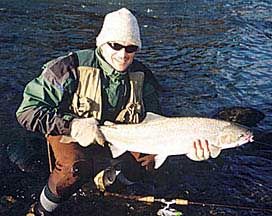 Steelhead are one of the most elusive species of fish alive. Anglers the world over make their way to rivers, lakes, coves, inlets and bays in the hopes of hooking into that once-in-a-lifetime fish. This page will focus on the most talked about subject matter without going into minute details. Expect to learn many things from this page you didn’t know before, but supplement this information with the referred books at the end of this article and you’re sure to hook steelhead many times sooner than someone who doesn’t.
Make every effort to determine the weights and ages of steelhead without killing them. If you have any questions feel free to e-mail me at tak@topfishingsecrets.com Enjoy!
Steelhead

Oncorhynchus mykiss
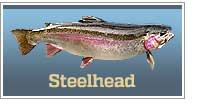
Steelhead a.k.a. Steelie, Chromer, Salt fish, and Metal-head are sea-run rainbow trout. Ideal water temperature: 44° to 50°
world record: 33 pounds, 0 ounces
They’re excellent fighters on any test of line, though hooking into them with light line promises to put up battles remembered for many years to come. Identification: the single best way to begin identifying steelhead is to count the rays on the anal fin. The rays should be 12 or less. Steelhead have a white mouth and gum line. There is a distinctive red to pink band that follows the length of the lateral line from the head to the tail during spawning season. When they’re not in the spawning stages steelhead are predominately chrome. Spots run the length of the body but are prominently displayed along the back from the head to the tail. Depending on the region, the color of the top of the head can be light to deep olive green. The average weight of a steelhead is subjective, the further north you go the longer fish live, but tend to be smaller than their southern counterparts. The world record for steelhead is constantly debated, but most anglers, guides, and scientists agree on 42-pounds. See exciting action in the steelhead fishing videos section.
Distribution
Steelhead can be found throughout the entire range of temperate waters the world over. The agreed upon parallels are 30 to 60 degrees identifying every body of water between them as temperate. The Lions share of popularity belongs to North America with Americans dominating the sport. Steelhead are anadramous, and migration runs are broken down into groups of seasons (Fall, Winter, Spring, and Summer) in fresh and saltwater systems. Each season brings its own brand of fishing techniques that must be employed to catch them for both environments. Lifespan: Steelhead have been said to live as long as 18-years. Most experienced anglers and guides focus on a range from 6 to 9 years with scientists stating longer. The size and weight of steelhead is largely dependent on the geographic location. Temperature plays a key role in the life expectancy of steelhead with the southern species living the shortest lives but attaining sizes of world record proportions. The northern species of steelhead live the longest and grow the slowest. The reason for the longevity of steelhead in northern regions is said to be from the cold water, which stymie the growth of fungus, parasites, and other diseases that drastically shorten the lifespan of the southern species.
Angler value
Anglers see it as extremely high. It may be the one species that is caught in every corner of the world, ironically, the domesticated fisheries is almost non-existent lending to the notion that steelhead may be one of the toughest species of fish alive. Techniques of fishing: the most prolific technique is Drift-Fishing. Drift-Fishing is designed to use the currents of any body of water that has movement. Whether on a boat, bank, pier, or shoreline, with the applications of drift-fishing the chrome beauties known as steelhead can be caught by anyone with the wiliness to go after them. Some of the other successful fishing techniques are fly fishing, plunking, spinners, spoons, and bobber-jig. Seasons to fish: Steelhead can be caught virtually year-round. Consult the regulation handbook in your area to get the specifics of when and when not to fish for them. The height of each season is largely based on the middle of each run of fish; that is to say, when the fall run begins in September then the best time to fish for them would be late October through the month of November. Use this example for every season of the year.
Since steelhead warrant special attention it’s also best to give these great fish the same consideration when writing about them; to that end, this section of the page is dedicated to showing in greater detail Distinctive Physical Qualities, Gauging Size with Calculations, Feeding habits, Fighting Capabilities , Open Sea Migration and Inland Migration, and Spawning Cycles.
A steelhead is a seagoing rainbow trout. A steelhead’s mouth and gum line are white. Steelhead have a red stripe that begins at the gill plate and runs the length of the body along the lateral line. The stripe becomes darker as they get closer to the predetermined spawning cycle. The twelve rays on the anal fin make aid in the identification of a trout. Many fishermen describe returning steelhead by the “salt” age. A three year salt hatchery fish is actually a four-year old fish. Since natives spend an average of two years in the natal stream add those years to the salt age of returning natives, so if a returning native has spent three years at sea add 2 years making the fish 5 years old. There is a relatively reliable way of gauging a fish’s age by the size of the fish without removing scales thus preventing the imminent spread of fungal disease. A mathematical calculation allow for another option rather than “landing” a steelhead when anglers intend to release them back into the blue. These templates are recognized by Washington Department of Fish and Wildlife, and the National Wetlands Research Institute for the United States of America as well as many other state and national departments for the U.S.
Measurements for documenting the age of steelhead:
18.58 inches for 1 year
27.6 inches for 2 years
32 inches for 3 years
34.6 inches for 4 years
Formula for equating weight of all anadromous species:
L x girth² / 800 = or 37” x 22” x 22” ÷ 800 = 22.38 pounds
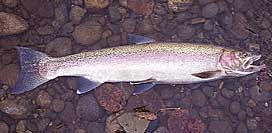 Take a look at this awesome fish! It has all the hallmarks of a classic Steelhead. The pink band from the head to the tail is one sign indicating that it’s a steelhead, but there’s more. Note the heavy mottling from the top of the head to the tail. The spots are prominently displayed on the top of the fish as well as the entire tail. The pink cheeks of steelhead can be seen most of the time they’re in rivers, lakes, and estuaries. The rays of the anal fin are 12 or less, which distinguish it from salmon. This particular fish was taken amongst hundreds of spawning Chinook. Steelhead are very particular about the offerings they’ll take, and in this case it was relatively easy for me to ascertain what it would take to make him bite while preventing the salmon from hitting the hook. To the many anglers who have heard about this story and the article that went with it (Steelhead & Salmon Warfare) it made them wonder just how long the competition between steelhead and salmon has existed. Scientifically, the competition makes sense since they share the same waterways at the same time and are members of different species.
Steelhead will feed on squid, copepods, crustaceans, and smaller baitfish such as sand-lance and smelt. Though salmon can often be found holding in the same area they will often not take the same baits or lures. The problem with reliably predicting food sources that will stimulate steelhead is they don’t school in the ocean the way salmon do. They tend to run deeper and away from major commercial fishing lanes; therefore making it that much more difficult to track their feeding habits. However; steelhead that area caught in estuaries are taken on offerings too small for Chinook but larger than that of Coho.
Fishing for steelhead in an estuary can be risky business if you don’t make the distinction in tackle. Steelhead prefer spinners fished very deep or they will hit small zingers and buzz-bombs that are fished deep but slowly. Scent and cover is the thing to remember when fishing for them in the estuary. Don’t fish for them from shore without getting into the water at least knee high to hide yourself from sight. Fisherman who fish from the shoreline are often seen by this elusive fish because they are higher than the waterline and that makes them easy to see and it will be enough to put any fish in the area off the bite. The best way to fight a steelhead is pretty much the same way you would in a river; they’re every bit as acrobatic in the estuary and that’s what makes them so hard to land. In an estuary they have room to run and flail about but one of the first things they tend to do is head for the nearest structure and if there’s nothing in the water for them to head for then you’re the next best thing and they’ll head straight for you at top speed. As it streaks towards you reel and walk backwards at the same time until it turns. As it runs make sure to “palm or thumb” the spool to give maximum tension on the line, but only for a few seconds at a time. Don’t reel against the drag. Each time it jumps lower the rod tip into the water to take up any slack, the moment it is back in the water put your rod tip back up high and play it out. Typically, when a steelhead has done all it can to throw the hook it will come in relatively easy but be prepared for the fish to bolt the second you attempt to tail or net it. “Cover” is the key to finding steelhead, but drop-offs are an excellent place for holding steelhead too.
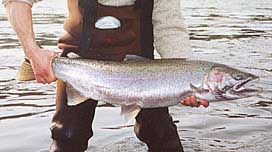 This great looking Steelhead was taken during the winter run. Native steelhead tend to strike harder and much more difficult to land than hatchery fish. The tenacity of steelhead become apparent when they purposefully migrate to the other side of wide rivers in an attempt to avoid contact with anglers. While they don’t clearly understand people, they certainly appreciate the shadows they cast causing them to believe that a predator is about.
This steelhead was taken on extremely light line, six-pound test to be exact. By employing tricks used in Steelhead & Salmon Drift-Fishing Secrets, this angler was able to keep it from running downstream where white-water would have destroyed the light line. Winter run steelhead begin their migration inland during the fall months and stay until spring; that can be a total of two to six months without eating on a regular basis. Winter run Steelies tend to be more full and rotund than the summer run of fish, which are longer and sleek, and much harder to solicit strikes with the low running rivers and streams.
Migration into freshwater systems are another distinction that steelhead have over salmon. Salmon will wait for an inundation of rivers and streams before attempting to go upstream, steelhead do not, they can go up anytime that oxygen and temperatures permit. They will also migrate in high muddy water as well while salmon will hold close to the banks waiting for the river to recede. Finding steelhead once they enter rivers is broken down into two seasonal tactics. During the fall and winter months where rivers and streams often run high and muddy conditions make it easy to approach holds without spooking fish. Summer run fish are harder to approach only because waters run low and clear; getting to the river at dawn or dusk is the best approach. Drifting downriver into deep holds are excellent places to fish when the sun is high. The most reliable times to get them to bite are at dusk and dawn, but that doesn’t mean they won’t bite any other time. Consider that their eyes acclimate to dark much better than visible light and that is why your presentation during times of dusk and dawn should be well thought out and prepared in advance.
Offerings in rivers are much more diverse than is with salmon making them much more finicky to catch. Eggs, Sand Shrimp, Earthworms, Flies, Corkies, Spinners, and Spoons are just a sampling of what they will take but knowing what the prevailing offering is during times of high pressure, from fishermen, is the thing that will get you fish. Changing your offering to something that hasn’t been used almost always garners a strike immediately. Winter run steelhead enter rivers as maturing adults and spend 1 to 2 months for the late fish but those the arrive early have been known to stay in fresh waterways for six months before they spawn and head back out to sea. Summer run steelhead enter rivers as sexually immature and will spend months in a river before it spawns. The average amount of time summer run steelhead spend in rivers is almost never less than six months which figures since they’re much thinner and more sleek than the fall and winter runs. Though steelhead will strike at natural offerings in rivers it’s understood by many ecologists and fishermen that they do not feed. It has been said, many times, that steelhead are territorial enough that holding areas are kept clean of debris and unwanted offerings are taken into their mouths, Steelhead will then move backwards downstream, and spit back out and away from the area without fishermen feeling a thing; that is why using highly-visible mainline line will help you detect strikes. Lines that travel the drift and suddenly slow down or stop are, more often than not, strikes; when it happens set the hook and the fight will be on.
AA-Fishing wishes to extend a debt of gratitude to Timothy Kusherets of for contributing a wealth of knowledge about salmon and steelhead fishing. To find more about fishing for steelhead and salmon go to Top Fishing Secrets on the web by the author Timothy Kusherets @ www.topfishingsecrets.com The site offers articles, tips and advice, species identification, fishing techniques, River and Lake levels, Tides, and Weather. The pages of the site are designed for every level of angling skill.
See listing of world records and Mr. Kusherets personal bests here.
Recommended Reading:
Steelhead & Salmon Drift-Fishing Secrets
by Timothy Kusherets
Float Fishing for Steelhead
Dave Vedder
Steelhead Drift-Fishing
Bill Luch
The Steelhead Trout
Trey Combs
Pacific Northwest Weather
George R. Miller
Related Articles
Trout fishing by state


021926
Contribute Steelhead Fishing Information
If you have information, articles or photos relating to steelhead fishing which you would like to see published here, please submit them for consideration. We will gladly give you credit for your contribution. Steelhead articles can be listed under the general steelhead articles category of the main fishing articles page, or can be listed under steelhead articles in a specific state.
If you offer steelhead fishing guide services, you can choose from two listing options to promote your guide services, by visiting our advertising section.
Fishing Information